

Today’s audio grounds the principle that a mind on fire stabilizes not because it is controlled, but because it is no longer required to manage threat. It comes from a 7-part Somatic Regulation series I taught last fall, now in my Member’s Library. The series explores how periods of change often require welcoming dysregulation as part of risk and creativity, and how to return to center without collapsing into old patterns.
I was in the middle of writing this when I went to see Hamnet, largely unrelated to today’s Substack, but I’ll get there. The way Chloé Zhao brings nature forward as a living presence rather than a backdrop is breathtaking. The film’s viscerally devastating portrayal of love and loss finds a way to gut you and make you want to feel all of it…more. I walked home afterward, searching for interviews with Zhao to understand what she was intending that made this movie so deeply felt.
In one interview, she spoke to the vulnerability of pushing one’s work into the world. Its reception or rejection is as existential an experience as it is egoic. For those whose artistry feels inseparable from their identity, whose work lives as close to the soul as anything can, rejection, whether real or perceived, can register as a threat to belonging itself. Because we are a social species dependent on connection for survival, any suggestion of exclusion can feel like a rejection of the most authentic parts of ourselves. Anyone who has tasted rejection, of any kind, can attest to the obsessively rehashing mind that follows close behind.
I can’t remember who taught me that rejection often breeds obsession, but when I observe the looping mind, it’s easy to see why. The pain is so specific and destabilizing that the mind launches into relentless inquiry. What did I do wrong? Who should I have been? What could I change? As if one perfect answer might undo the pain of not being wholeheartedly adored, or more miraculously, let us rewrite history within our own minds.
Rejection breeds obsession not because we are weak and neurotic, but because something essential has not yet landed. This is why spiritual platitudes like “rejection is protection” or “they didn’t reject you, they’re just rejecting themselves” may offer brief comfort but rarely reconcile anything real. They do not close the loop. They fail to give the nervous system what it needs to metabolize the experience, and so the mind circles the wound, scanning for what it might have missed, hoping one more pass will make the incomprehensible…manageable.
A more nuanced view is that the looping mind is innocently trying to resolve what it cannot yet understand. If only I could see this differently. If I shift the angle by one degree, maybe this will finally make sense.
For these and many other reasons, I wonder if people have noticed their minds becoming more obsessive as of late, particularly around experiences of exclusion. Perhaps this is due to the sheer volume of content we encounter to identify with or reject. Every swipe, comment, and like acts as a mini impression of what I agree with and what I am against, and amidst all this positioning, it becomes harder to know who we actually belong to or who belongs to us. The erosion of shared structures that once made reality intelligible seems to compound this confusion.
One of the most significant contributors to obsession is the Default Mode Network. The DMN governs self-referential thinking, rumination, and the maintenance of identity. It fills mental space with rehearsals of the future, replays of the past, and constant insistence: “this is who I am.” Through predictive processing, it attempts to reduce uncertainty by forecasting outcomes and preserving a coherent sense of self over time. Its aim is continuity, not clarity.
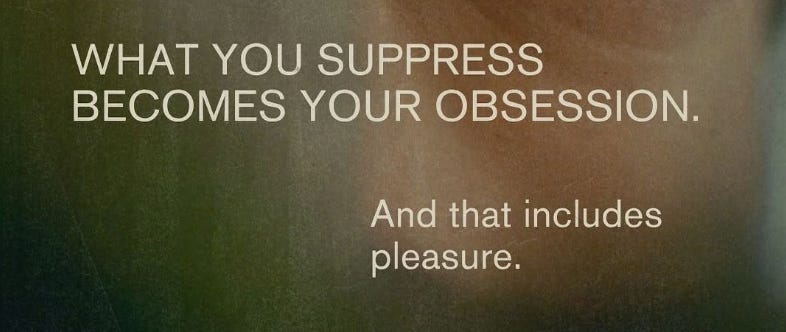
The DMN functions as the keeper of identity. When the ground feels unstable, it rushes in with story. When certainty collapses, it offers prediction. When we attempt to silence it through distraction or suppression, it often grows louder because it is attempting to close a loop it has not yet been able to complete.
So we attempt to quiet the mind, which, as anybody with an obsessively looping mind knows, can feel like trying to stop a moving river with your hand. Discipline wants to, obsession has to.
Even trickier, stillness without safety can backfire. When the body is idle but does not feel secure, the nervous system braces and the DMN ramps up. Meditation, done without adequate resourcing or real grounding, can feel like one step forward and two steps back. An unsafe system left alone with itself will fill silence with unhelpful stories.
All of that said, I have also seen how more people are breaking up with old strategies of outsourcing their regulation. No longer finding safety in fantasy and institutions, or clarity in narrative alone. They are discovering that the mind becomes a coherent and creative instrument when given what it actually needs during instability. When someone learns to belong to themselves and their intimate circles by orienting to the present moment and reestablishing contact with what is happening in their immediate world, regulation is taken back into their own hands. This does not mean we stop needing one another. It means we start going to the places that actually provide what we need and how we need it.
Neuroscience supports this. DMN activity decreases during present-moment, task-oriented attention, while task-positive and salience networks come online. In plain terms, when we are embodied, engaged, and directly experiencing what we are doing, narrative threats become quieter. Adding even modest self-compassion further reduces DMN intensity and improves emotional regulation. This is not a belief system but a physiological condition.
With all of that said, obsession can be a beautifully productive phenomenon. Not something to be understood or quieted, but allowed to be the exact inner storm we need to be consumed by passion, transform pain, or find creative urgency. To be so caught in the mind that, amidst the storm, identity loosens just enough for something more honest to speak. Obsession may arise when we are attempting to metabolize beauty too big to understand, to let loss and love map new terrain, or to become the fuel we need to branch into a new chapter.
I believe deeply that having internal systems that cannot be easily hijacked by overwhelm is a form of power, and that the critical mind is not an enemy but a messenger for when our lives are asking for contact rather than coping.
Thank you for reading, listening, and helping everyone you can through your practice.
Love, A
I've recently updated my online Member’s Library with over 40 videos from the Somatic Regulation Series: Weathering the Storm. These 3- to 20-minute practices in breathwork, somatic embodiment, and meditation are designed for moments when you feel stuck, reeling, or despairing, or when things feel good and you want to stabilize a new state. From where I stand, the world is not letting up. The demands on our attention, hearts, courage, and creativity continue to grow. This library will be updated constantly and is available without time limit.
I’m very excited to be joining an incredible team in Antarctica for The Future of Humanity - March 8 to 17. A once-in-a-lifetime trip, where towering ice, mind-bending landscapes, wildlife, and vast silence for reflection, creativity, and connection to the larger world. This adventure is an opportunity to witness the delicate balance of our planet, engage with visionary thinkers, and explore what it means to live in harmony with the Earth and each other. Message me for discount codes if interested.